Choosing a church job is about more than filling a vacancy. The best ministry fit is one that aligns with your strengths, your personality, and the way God has wired you to serve. When someone’s natural inclinations match the demands of their role, they tend to feel more engaged, more effective, and more likely to sustain their work over time.
Every church needs a healthy mix of leaders, creators, caregivers, organizers, and visionaries. Myers-Briggs personality type (MBTI) can be a useful lens for thinking through where someone may thrive, especially alongside calling, skills, theology, and spiritual maturity. This guide is not a hiring formula. Think of it as a conversation starter, one that helps people identify where they may feel most at home and gives churches a framework for stewarding different kinds of gifts well.
Why Personality Matters in Ministry
Not every gifted person flourishes in the same environment. Some leaders are energized by public-facing roles. Others do their most meaningful work out of the spotlight. Some bring structure and process; others bring imagination and relational depth. When church roles align with personality, people are generally more engaged, more effective, and more likely to stay healthy in their work long-term. That’s good for the individual. It’s also good for the church.
MBTI is not a perfect tool and should never be used in isolation. Even so, it can offer real insight into the kinds of church jobs for every personality type in ministry, along with what may feel natural and energizing. Use this guide alongside prayer, discernment, and honest conversations with trusted leaders as you think through your next steps.
Want to download the PDF? Click here.
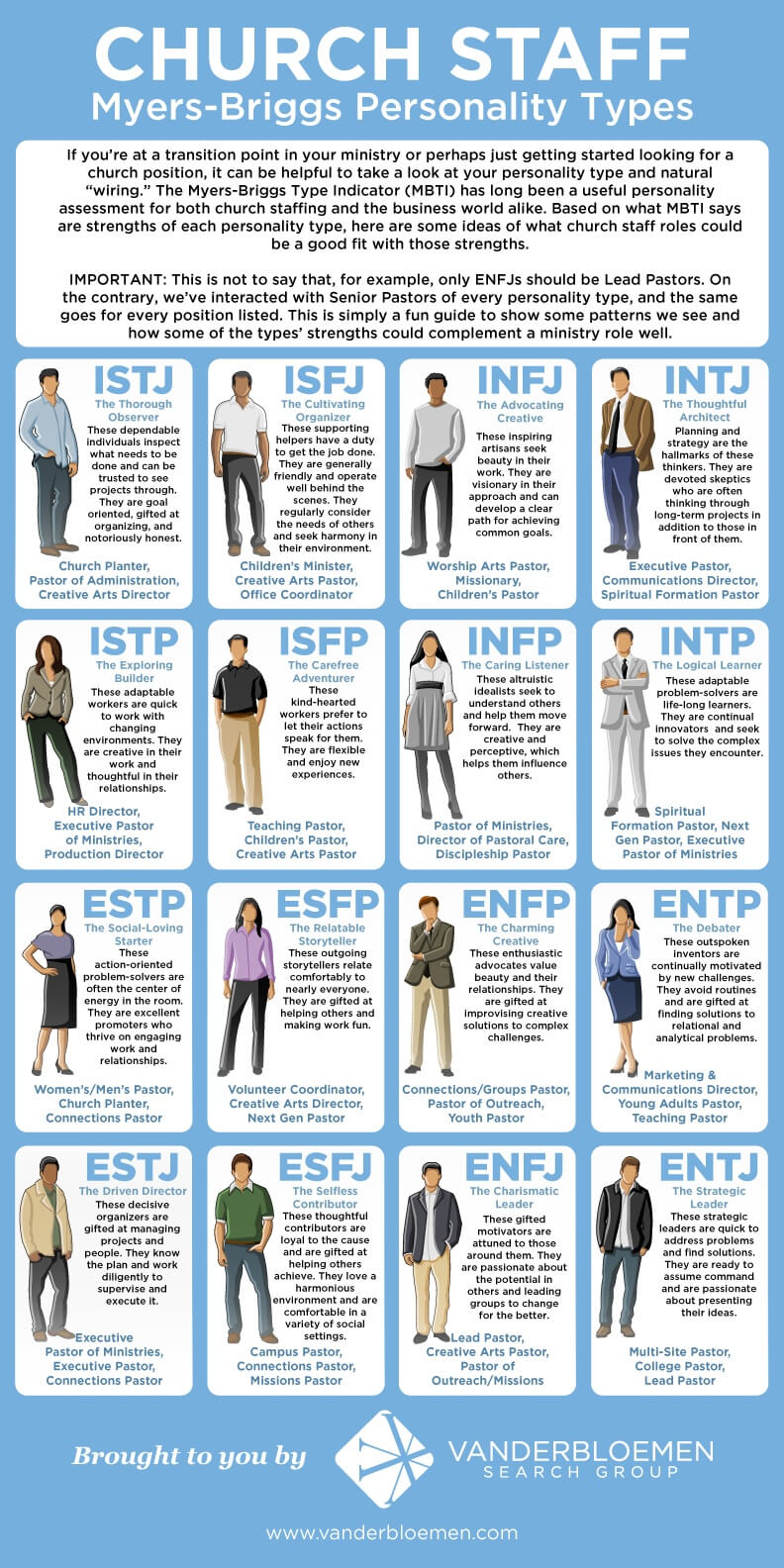
ISTJ: The Thorough Observer
ISTJs are naturally drawn to structure, clarity, and personal accountability. They tend to be reliable and detail-oriented, focused on completing tasks accurately and with integrity. In ministry, they bring steady, dependable leadership, especially in roles that require organization, precision, and trust. Their commitment to consistency gives the broader team a solid foundation to build on.
They thrive in environments where expectations are well defined and systems are thoughtfully built. Rather than chasing recognition, they quietly make sure operations run efficiently. During periods of change or uncertainty, ISTJs bring a methodical, grounded approach that keeps things moving. Others lean on them precisely because they follow through.
Possible church jobs:
- Church Planter
- Pastor of Administration
- Creative Arts Director
ISFJ: The Cultivating Organizer

ISFJs are steady, dependable, and deeply attuned to the needs of others. They are driven by a genuine desire to serve well and to create spaces where people feel welcomed, supported, and known. In ministry, they bring a quiet strength that helps teams operate with both consistency and compassion. Thoughtful, detail-oriented work is something they take real pride in.
They are especially perceptive when it comes to relational and emotional dynamics, often picking up on unspoken needs before anyone else does. ISFJs flourish in structured settings where trust builds gradually through consistent care and follow-through. Their contributions are often behind the scenes. They are rarely the loudest voice in the room, but they are frequently the reason the room holds together.
Church role options:
- Children’s minister
- Creative Arts Pastor
- Office Coordinator
INFJ: The Advocating Creative
These purpose-driven leaders are shaped by deep insight and a desire to create lasting, meaningful impact. They reflect carefully on both people and possibilities, bringing vision and empathy into the same room. INFJs approach ministry with intention and depth, drawn especially to environments where growth, alignment, and shared purpose can take root over time.
Strong internal conviction guides them, even when their perspective is not yet visible to others. They have a natural ability to recognize underlying tension within teams or organizations, often identifying misalignment before it surfaces as conflict. Their reflective pace leads to thoughtful, deliberate decisions. In ministry, they help teams stay grounded in both mission and relationship.
Best fit roles:
- Worship Arts Pastor
- Missionary
- Children’s Pastor
INFP: The Caring Listener

Reflective and values-driven, these leaders bring deep compassion and a genuine desire to understand the people around them. They approach ministry with thoughtfulness, creativity, and strong personal conviction, which allows them to serve with real authenticity. INFPs make an impact through attentive listening, steady encouragement, and a sincere commitment to helping others grow. Roles requiring empathy, trust, and meaningful connection tend to be where they shine.
INFPs are energized by work that feels purposeful and aligned with what they actually believe. They build deep, lasting connections and often carry a quiet but powerful influence in pastoral care and discipleship settings. Overly rigid environments can feel stifling. Give them flexibility, trust, and relational depth and they will flourish. Their gift for recognizing and affirming the unique value in others tends to produce change that’s slow to appear and slow to fade.
Ministry role ideas:
- Pastor of Ministries
- Director of Pastoral Care
- Discipleship Pastor
INTJ: The Thoughtful Architect
INTJs think in systems, patterns, and long-term outcomes. They gravitate toward roles that reward careful planning, independence, and strategic execution. In a church setting, they add the most value when leadership needs clarity, structure, and a credible path forward. Analyzing problems, designing better processes, and aligning resources around a clear mission are the kinds of challenges they find genuinely interesting.
They lead with a future-oriented mindset, building pathways toward a goal others may not have fully articulated yet. INTJs value efficiency and purposeful design. They work best in environments where strategy is prioritized over routine. Complex challenges tend to sharpen them rather than slow them down, and their ability to translate big-picture thinking into actionable plans makes them a valuable anchor in any leadership team.
Roles that may fit well:
- Executive pastor
- Communications director
- Spiritual Formation Pastor
INTP: The Logical Learner

INTPs are drawn to ideas, questions, and complex problems. Research, analysis, and improvement energize them, especially when they have the space to think deeply and work carefully. In ministry, they contribute by identifying weaknesses, refining systems, and bringing fresh perspective to challenges that have stumped others. Hierarchy holds little appeal for them. Sound reasoning does.
These independent thinkers prefer flexibility and the freedom to explore concepts at their own pace. They excel when given room to develop insights, connect abstract ideas, and approach problems from unconventional angles. In ministry settings, what they offer is often quieter than what others bring, but no less important: depth, honest reflection, and a kind of intellectual rigor that makes the team sharper.
Suggested ministry positions:
- Spiritual Formation Pastor
- Next Gen Pastor
- Executive Pastor of Ministries
ENFJ: The Charismatic Leader
ENFJs are natural encouragers who care deeply about people, development, and shared direction. They thrive when leadership, teaching, and relationship-building converge. Their ability to connect with others and guide them toward meaningful growth makes them especially effective in ministry settings. They also carry a strong instinct for recognizing potential and helping people step confidently into their strengths.
They communicate vision in a way that motivates people to move together with clarity and purpose. ENFJs are attuned to the emotional and relational dynamics of a team, and they work hard to build unity and trust. Investing in others energizes them rather than draining them, and their influence often shapes both the trajectory of an organization and the sense of community within it.
Recommended church roles:
- Lead Pastor
- Creative Arts Pastor
- Pastor of Outreach/Missions
ENFP: The Charming Creative

ENFPs are energetic, imaginative, and genuinely relational. Fresh ideas, meaningful conversations, and environments that welcome exploration are where they come alive. In ministry, they bring enthusiasm and a natural ability to communicate vision in ways that feel hopeful and engaging. They are curious about people and often see opportunities to build bridges between groups and ministries that others have overlooked.
They are perceptive about cultural shifts, often identifying emerging needs and opportunities ahead of the curve. ENFPs flourish in flexible, people-centered environments where creativity and connection come first. Detailed administration may not be their strongest area, but they more than compensate through inspiration, big-picture thinking, and an ability to get people genuinely excited about what is possible.
Church positions to explore:
- Connections/Groups Pastor
- Pastor of Outreach
- Youth Pastor
ENTJ: The Strategic Leader
ENTJs bring confidence, decisiveness, and a clear desire to lead toward results. They are comfortable making tough calls, clarifying direction, and aligning people around a common goal. In church leadership, they tend to excel when momentum is needed, accountability has lapsed, or a team requires sharper execution. Complex responsibilities do not intimidate them.
They are drawn to leadership in fast-moving environments where clear direction matters most. ENTJs think strategically about growth and long-term impact, always asking how teams and systems can be structured for greater effectiveness. They take ownership seriously and push initiatives forward with discipline and purpose. Where others see complexity, they see a roadmap waiting to be built.
Ministry roles that may suit:
- Multi-Site Pastor
- College Pastor
- Lead Pastor
ENTP: The Debater

ENTPs are drawn to big ideas, lively discussion, and solving new problems in unconventional ways. They bring real energy to brainstorming sessions and often push teams to question assumptions in ways that lead to better outcomes. In ministry, they thrive where innovation, adaptability, and fresh thinking are actually welcomed. “The way we’ve always done it” is rarely a satisfying answer for them.
They are especially skilled at connecting ideas that seem unrelated and spotting opportunities others walk right past. ENTPs think quickly in conversation, helping teams move from vague concepts to actionable direction. Their curiosity drives them to consider multiple perspectives before settling on a solution, which usually leads to more well-rounded outcomes. In ministry, they are often the ones who reframe a challenge entirely and unlock a path no one had considered.
Church staffing options:
- Marketing & Communications Director
- Young Adults Pastor
- Teaching Pastor
ISFP: The Carefree Adventurer
ISFPs value authenticity, beauty, and the freedom to express themselves in ways that feel genuine. They tend to be more at home in calm settings where they can serve creatively and thoughtfully, and they often make a strong impact without calling attention to themselves.
In church environments, they bring warmth, sensitivity, and a refined sense of artistry that helps people feel at ease. Overly rigid or formal structures rarely suit them. They flourish where there is space to contribute in a personal, hands-on way. Their awareness of emotional tone and visual aesthetics makes them especially effective in creative, worship, or relational ministry contexts.
Ministry paths that may align:
- Teaching Pastor
- Children’s Pastor
- Creative Arts Pastor
ISTP: The Exploring Builder

ISTPs are practical, levelheaded, and quick to recognize what actually needs attention. They prefer concrete, results-oriented work, and they are usually more energized by solving problems through direct action than through extended discussion.
In ministry settings, they tend to be most effective in roles that call for steady, behind-the-scenes support. Their natural adaptability, along with their comfort with tools, systems, and equipment, makes them a strong asset whenever something needs to be fixed, improved, or simply kept running well.
Roles worth considering:
- HR Director
- Executive Pastor of Ministries
- Production Director
ESFJ: The Selfless Contributor
ESFJs are often people-focused, structured, and naturally attentive to what others need. They usually enjoy creating environments that feel warm, organized, and inclusive, and they tend to notice quickly when someone needs support or does not yet feel connected.
Service energizes them, and they find real satisfaction in helping a group stay healthy, welcoming, and coordinated. In leadership settings, they tend to excel at managing details, encouraging broader participation, and maintaining the relational ties that hold a team together over time.
Suggested church positions:
- Campus Pastor
- Connections Pastor
- Missions Pastor
ESFP: The Relatable Storyteller

ESFPs bring natural energy to the people and spaces around them. They prefer dynamic environments, hands-on involvement, and opportunities to connect with others in real time. Standing still does not suit them.
In ministry, they tend to shine in settings that call for encouragement, momentum, and a sense of celebration. Their ease with people and quick responsiveness make them especially effective at building connection, lifting energy in a room, and keeping a group moving forward together.
Potential ministry placements:
- Volunteer Coordinator
- Creative Arts Director
- Next Gen Pastor
ESTJ: The Driven Director
ESTJs bring structure, leadership, and a strong sense of responsibility to any role they take on. They thrive when systems need to run efficiently, people need clear direction, and goals must be hit with consistency. In ministry, they serve as a stabilizing force that helps teams stay focused, organized, and accountable. They appreciate environments where expectations are direct and standards are upheld.
Organization comes naturally to them, and they tend to excel at managing operations, timelines, and team performance. Decision-making is rarely a struggle for ESTJs. They carry through on commitments and expect others to do the same. In ministry settings, they are the people who turn vision into dependable, day-to-day action across teams and departments.
Potential church vocations:
- Executive Pastor of Ministries
- Executive pastor
- Connections Pastor
ESTP: The Social-Loving Starter

ESTPs are lively, practical, and quick to respond when a situation demands it. They prefer fast-moving environments that give them room to adjust, solve problems, and make decisions without waiting for a committee to weigh in.
In ministry, they tend to bring urgency, energy, and a steady push toward progress that keeps teams from drifting into stagnation. Their hands-on approach and natural ease with people make them a strong fit for roles that require responsiveness, movement, and impact people can actually see.
Ministry opportunities to consider:
- Women’s/Men’s Pastor
- Church Planter
- Connections Pastor
What to Remember About Personality and Ministry
Personality can point toward a good fit. It cannot replace calling, theological alignment, character, or skill. The healthiest church teams are built through both spiritual discernment and careful evaluation. A good role is one that allows someone to use their gifts well, grow in maturity, and stay emotionally and spiritually healthy over the long haul.
MBTI is not a definitive map, but it can help people identify where they feel most at home and where they may need support from others. Whatever your type, the best fit is ultimately the one that lets you serve with excellence, genuine joy, and long-term fruitfulness.